
Ghosting Explained: What the Research Says About Why It Happens, What It Does to You, and How to Respond
By Derek Kane
You had a good first date. The texting was easy, the plans sounded real, and then the replies slowed down, got shorter, and stopped. No argument, no explanation, just silence. If that sounds familiar, you are far from alone. In a series of U.S. studies, between 23 and 25 percent of adults said they had been ghosted, and between 19 and 22 percent said they had done the ghosting themselves. Researchers believe those numbers undercount the real rate, because people view ghosting negatively and tend to underreport it.
I came up in boxing, where the punch you never see coming is the one that does the damage. Ghosting works the same way. A clean rejection you can process, but silence leaves you swinging at nothing. This guide covers what ghosting actually is, how common it really is, why people do it, what the research says it does to the person on the receiving end, and a practical playbook for responding with your self-respect intact: no chasing, no spiraling, and no revenge. It also covers how to end things without becoming a ghost yourself, and the situations where disappearing is the right call.
What Ghosting Actually Is
Researchers define ghosting as a unilateral discontinuance of communication with another person without explanation. That means one person stops replying, stops calling, and stops engaging, and never says why. It can happen after one date or after a year, in romantic relationships, friendships, and even at work. What makes it different from a breakup is the missing explanation. The person on the receiving end gets no closure, no reason, and no chance to respond.
Ghosting also has relatives that tend to travel with it. Breadcrumbing is giving someone just enough attention to keep them interested without ever committing to anything real. One study of Spanish adults found that about 36 percent said they had been victims of breadcrumbing. Orbiting is cutting off direct contact while continuing to watch your stories, like your posts, or otherwise hover on the edge of your life. Researchers have studied ghosting and orbiting together as increasingly common ways to end relationships through social media. If you have ever been ghosted by someone who kept viewing your stories, you have met both.
How Common Is Ghosting?
The best U.S. numbers come from research led by Gili Freedman and colleagues. Across three studies with a combined 1,548 participants (554, 247, and 747), between 18.9 and 21.7 percent said they had ghosted someone, and between 23.0 and 25.3 percent said they had been ghosted. Other reviews put the share of adults who have been ghosted by a romantic partner between 13 and 23 percent. A YouGov survey of 1,000 U.S. adults found that just over 10 percent had ghosted someone to end a relationship.
Some surveys of young adults report much higher figures, with estimates of being ghosted ranging as high as 72 percent. The range is wide because studies define ghosting differently, sample different age groups, and rely on self-report. Researchers also note that no comprehensive global study of ghosting prevalence exists. What the evidence does show is that ghosting is common, that it is especially common in relationships that start online, and that many people have been on both sides of it. A 2024 analysis described it as a behavior linked to online-initiated relationships and to declines in emotional and physical well-being, which brings us to the next question.
Why People Ghost
There is no single reason, but the research points to a few patterns. The first is avoidance. Telling someone you are not interested is uncomfortable, and silence is easier in the moment. An informal BuzzFeed survey of people who had ghosted found that 81 percent said they simply were not into the person they ghosted. That is not rigorous research, but it matches what the academic work describes: most ghosting is about escaping an awkward conversation, not about a grand strategy.
The second pattern is structural. Dating apps, social media, and the relative anonymity of modern dating make it easy to disappear with almost no social cost. When you met through an app, you share no friends, no workplace, and no reputation to protect, so vanishing carries no consequences. The third is belief. Freedman and her colleagues found that people’s beliefs about relationships, including whether compatibility is fixed or something that can grow, predicted how acceptable they think ghosting is.
The fourth pattern deserves attention because it complicates the usual story. A 2024 study found that people who were ghosted significantly underestimated how much their ghosters cared about them. That does not excuse ghosting, but it suggests intentions and perceptions often diverge, and that the person who vanished is not always as indifferent as the silence feels. Either way, the practical takeaway for you is the same: their silence tells you about their communication habits, not about your worth.
What Ghosting Does to the Person Being Ghosted
Being ghosted hurts, and the research explains why. Freedman and colleagues found that being ghosted produces emotional pain that arises from a sense of rejection, and that it threatens basic psychological needs: self-esteem, belonging, a sense that your life has meaning, and a feeling of control. In plain terms, you lose the chance to understand what happened, and your brain keeps working on the problem anyway.
Communication researcher Leah LeFebvre has described how that ambiguity leaves people with unanswered questions and stuck in a loop of wondering what went wrong. That rumination is exhausting, and it feeds self-doubt because there is no alternative explanation to hold onto. LeFebvre and Fan also identified seven strategies that people use to cope with the uncertainty, some effective and some not. Cross-sectional research has linked being ghosted to depressive tendencies.
Keep this in proportion. The research is still young, much of it is correlational, and the effects vary by person and situation. One preliminary study of adults found no significant relationship between being ghosted and life satisfaction, loneliness, or helplessness. Ghosting after a single coffee date is not the same as being vanished on after a year together. But if the silence keeps replaying in your head, that is a normal reaction to an unfinished story, not a personal failing. If low mood lingers for weeks, talk to a doctor or a therapist.
The Dating App Factor
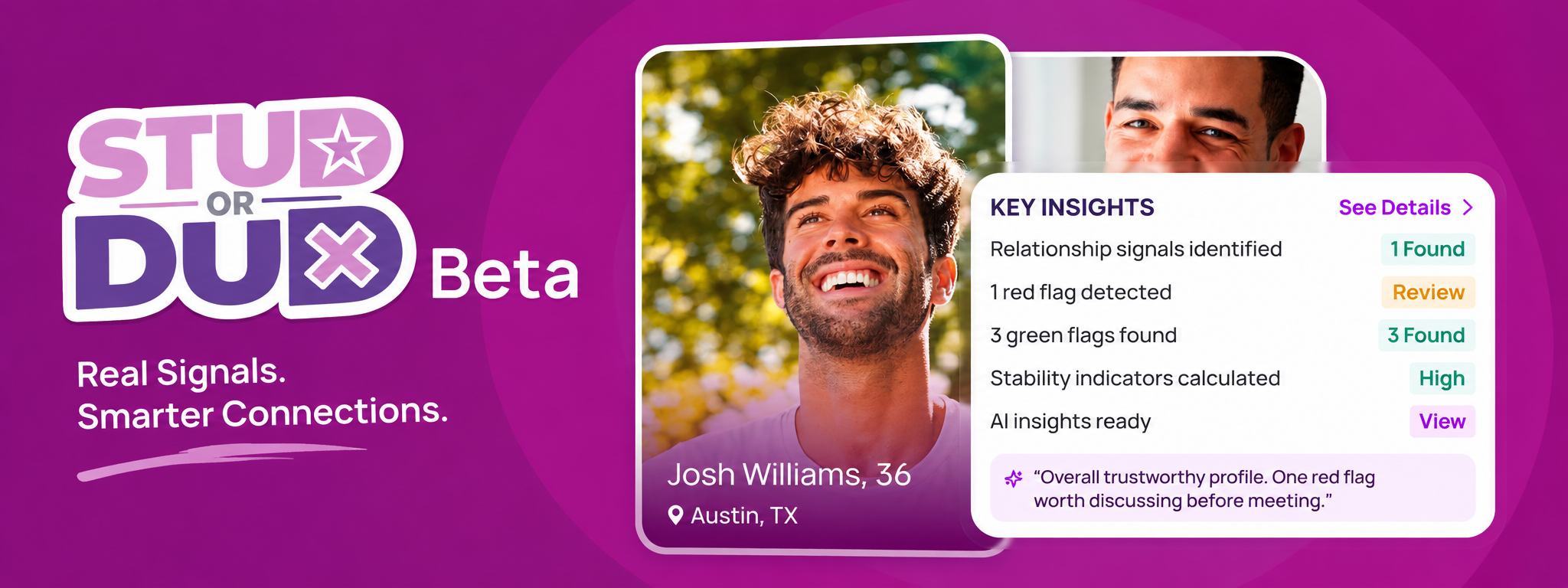
Apps have changed the math. According to Pew Research Center, 30 percent of U.S. adults have used a dating site or app, and 52 percent of those users say they have come across someone they believed was trying to scam them, a figure that rises to 63 percent among men under 50. Not every disappearance is a ghost in the human sense. Some of them are bots, fake profiles, or scammers who move on when you stop being useful. Our guide to Stud or Dud covers how to verify a match before you invest in one, and our online dating reality check explains why the numbers feel so lopsided for men.
The bigger structural issue is choice. When the pool looks endless, people treat conversations as disposable, and a match that fades is easily replaced. That is why ghosting is common in online-initiated relationships, and why the best defense is not a better opening line. It is a clear standard for how you communicate and how you expect to be treated.
Spotting a Likely Ghost Early
You cannot predict every disappearance, but certain patterns show up repeatedly. Treat these as signals to slow down, not as proof.
Vague plans. If she or he cannot commit to a day and a time, that is data. People who are interested make specific plans. Inconsistent replies. A burst of messages followed by a day of silence, over and over, suggests your conversation is competing with other options. One-way effort. If you are asking all the questions and carrying all the momentum, interest is probably lower than it looks. Cancelling without rescheduling. A cancelled date with no counteroffer is a soft exit. Breadcrumbs. A like, a meme, or a late-night message with no follow-through is attention without commitment.
None of these means someone is a bad person. They mean the match is not at the level of interest you want, and the sooner you notice, the less it costs you.
How to Respond Without Spiraling
Here is the playbook I give men who ask how to handle being ghosted.
1. Give it a day or two. People get busy, phones die, and weeks get chaotic. Do not read silence as rejection in the first 24 to 48 hours.
2. Send one follow-up, then close the loop. A single message, calm and without pressure, is plenty. Something like: "Hey, I enjoyed meeting you. If you are not feeling it, no hard feelings, just let me know so I am not guessing. Take care." That puts the decision in their hands and keeps your dignity intact.
3. Stop checking. Mute the thread. Stop watching their stories. If they are orbiting, do not feed it. Every time you check, you reopen the loop.
4. Do not retaliate. No guilt-trip messages, no flood of texts, no passive-aggressive posts. You will feel better for five minutes and worse for five weeks.
5. Treat it as information. Someone who disappears instead of saying a sentence is showing you how they handle discomfort. You just learned that cheaply, before investing more.
6. Reset your body. Train, sleep, eat, and get outside. In boxing, you recover from a rough round by getting back to your fundamentals. Our self-assessment on confidence and testosterone is a good place to start if your energy and mood have been low.
7. Keep moving. Do not wait around for one reply. Keep meeting people and keep your standards. Our 10 rules every man should know covers the boundaries that make this easier.
How to End Things Without Ghosting
If you do not want to be on the other end of this research, the fix is simple: say one honest sentence. You do not owe a long explanation, but you do owe a clear ending. Here is how I would handle it at each stage.
After a first date or a few messages. Keep it short and kind: "I enjoyed meeting you, but I am not feeling a romantic connection. I wish you the best." Two sentences, no debate. After several dates. Say it by phone or in person if you can. Texts are fine for the early stages, but someone who has invested real time deserves a real conversation. When it is mixed. Do not leave a door open if you mean no. "Maybe later" is just ghosting on a delay.
Remember the 2024 finding that people underestimate how much their ghosters care. A clear, kind ending costs you thirty seconds, and it spares the other person weeks of guessing.
When Ghosting Is the Right Move
There is one big exception, and it matters. If someone makes you feel unsafe, threatens you, harasses you, or pressures you for money, you owe them no explanation and no closure. Block them, save the evidence, and move on. That applies to aggressive messages, to people who will not take no for an answer, and to anyone who fits the pattern in our guide to stalking red flags. It also applies to romance scams: once a match starts asking for money, the right response is silence and a report, as we explain in our honeypot robbery breakdown.
Put Clear Intentions Up Front
One of the simplest ways to cut down on mixed signals is to choose platforms where members say what they want from the start. On AdultFriendFinder, for example, members state upfront whether they are looking for something casual, something ongoing, or just a conversation, which means far less guessing about interest. When both sides know the terms, there is less need to disappear, and a no is easier to say. If you want to meet people with that kind of clarity, start here.
Frequently Asked Questions
What is ghosting in dating?
Ghosting is ending contact with someone, usually by going silent, without any explanation. Researchers define it as a unilateral discontinuance of communication, and it can happen at any stage of a relationship.
How common is ghosting?
In U.S. studies, roughly 23 to 25 percent of adults said they had been ghosted and 19 to 22 percent said they had ghosted someone, and researchers think both numbers undercount the real rate.
Why do people ghost?
The main reasons are avoiding an uncomfortable conversation, losing interest, and how easy it is to disappear on apps. Beliefs about relationships also play a role, and some ghosters care more than their silence suggests.
Is ghosting a red flag?
A single disappearance after one date is common and does not make someone a villain. A pattern of vanishing and reappearing, such as breadcrumbing or orbiting, is a stronger signal that someone is not acting in good faith.
Should I text back after being ghosted?
Send one calm follow-up, then stop. If they resurface weeks later, you decide whether you want to engage. You do not owe a response, and you do not owe them an explanation for waiting.
How long should I wait before assuming I have been ghosted?
There is no research-backed number. A practical rule is to wait a day or two after your last message, send one follow-up, and treat continued silence for another few days as your answer.
Does ghosting hurt mental health?
It can. Research links being ghosted to emotional pain, self-doubt, and rumination, though much of the evidence is correlational and the effect varies by person. If a low mood lingers, talk to a doctor or therapist.
Is it ever okay to ghost someone?
Yes, when your safety is at risk. If someone threatens you, harasses you, or pressures you for money, blocking them without an explanation is the right move.
The Bottom Line
Ghosting is common, it hurts for real reasons, and it says more about the person who disappears than about the person left behind. Wait a day or two, send one follow-up, then close the loop and move on. Keep your body in shape and your standards high. And if you are the one who is ready to end things, say one honest sentence instead of becoming the silence someone else is stuck decoding. Real closure takes thirty seconds, and it is the difference between a man with self-respect and a man who simply vanished.
Interested in a link exchange with Real Entertainment Media? Our readers come here for straight, well-researched content on dating and modern relationships, which is exactly why they trust what we link to. We’re always open to swapping links or collaborating on guest posts with other sites in this space when it’s a genuine fit for both sides. Email marketing@realentertainmentmedia.com with the subject line “Att: Advertising REM,” or see more about working with us on our advertising page.
Want more? The Adult Entertainment hub covers everything else we publish, Educational Content goes deeper on topics like this one, Enhance Your Love Life is where the gear lives, and Casual Dating & Hookups is there when you want clear intentions from the first message.























No Comments Yet