Stud or Dud Explained: What This Dating Background Check Really Shows, and What It Can’t
By Derek Kane
Here is the number that should change how you approach online dating. According to Pew Research Center, 63 percent of men under 50 who have used dating sites or apps believe they have run into a scammer on them. That is the highest of the groups Pew broke out, and it comes from a nationally representative survey, not a forum poll. Meanwhile, FTC data shows romance scams cost Americans $1.49 billion in reported losses in 2025 alone. If you are going to meet strangers from the internet, a little due diligence is no longer paranoia. It is basic maintenance.
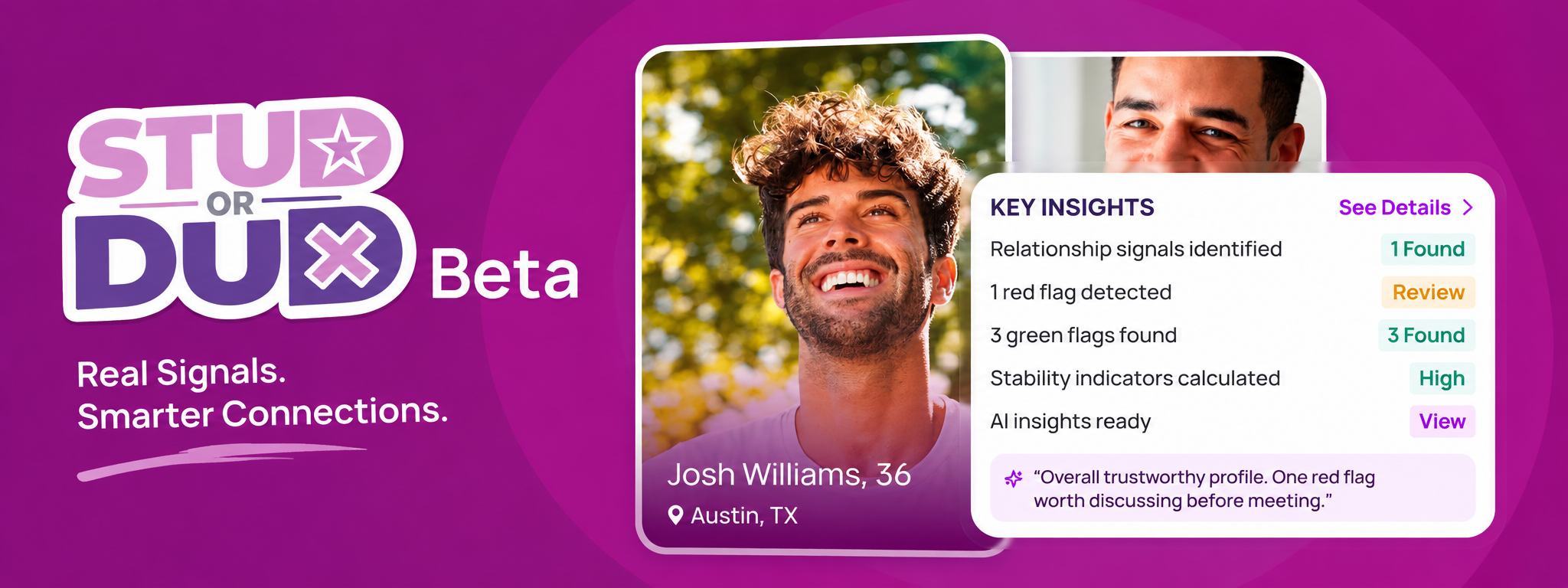
That is the gap a tool called Stud or Dud is trying to fill. Relaunched in its current AI-powered form on August 26, 2026 by the public-records company PeopleFinders, it lets you type in a name, a phone number, or just a first name and a city, then pulls what is publicly on file: addresses, court records, bankruptcies, property, business filings, and more. It is getting plenty of attention and just as much confusion about what it does, what it costs, and whether it is even free. This guide covers all of it, including the parts the marketing skips.
Why Vetting a Date Stopped Being Paranoid
Pew’s survey of 6,034 U.S. adults, conducted in July 2022 and published in 2023, is still the most thorough nationally representative look at online dating available, so it is worth reading closely. Three in ten American adults say they have used a dating site or app, and 9 percent had used one in the past year. Men are somewhat more likely to have tried it than women, 34 percent to 27 percent. And the experience is not all positive: 52 percent of users said they had come across someone they thought was trying to scam them. For men under 50 that climbs to 63 percent, compared with 47 percent for men 50 and older and 44 percent for women of any age.
Trust is thin across the board. Only 48 percent of Americans said online dating is generally a safe way to meet people, down from 53 percent in 2019, and about six in ten said companies should require background checks before someone can create a profile. Here is the interesting part: support for mandatory checks was lower among people who actually use the apps (47 percent) than among people who never have (65 percent). The takeaway is simple. The platforms are not reliably vetting your match for you, so if you want it done, you do it. Keep in mind that the Pew survey is a few years old, which is why the fresher money data below matters.
The financial numbers tell the same story. The FTC counted 64,003 romance scam reports in 2023, with $1.14 billion in reported losses and a median loss of $2,000, the highest of any imposter scam category. The latest figures, for 2025, show 70,588 reports and $1.49 billion in reported losses, according to FTC data reported this month. Those are only the cases people reported. The FTC’s guidance is blunt: a sad story paired with a request for money is almost always a scam, and anyone you have not met in person who asks for money gets a flat no.
What Stud or Dud Actually Is
Stud or Dud is built and run by PeopleFinders, a public-records company with more than 25 years in the business. The idea is not brand new. The first version launched around 2016 as a free iPhone app, and it was never a dating app itself. It was a companion to the apps you already use, a way to check on someone after you matched. The August 2026 relaunch rebuilt it as an AI-powered web platform. PeopleFinders CEO Amber Higgins described the aim as giving people additional context before they meet up while leaving the final judgment to the user.
The company says the information it organizes can include criminal, court, property, business, and other public-record data. Independent coverage adds address history, marriages, and bankruptcies to that list. The platform gathers those records in one place and then layers AI-written summaries on top, flagging items as green or red so you do not have to decode raw court filings yourself.
How It Works
The core feature is what the company calls Instant Signal Search. You enter a name, a phone number, or just a first name and city, and you get a snapshot of what shows up in public records. Every result comes back with a High, Medium, or Low confidence rating and the reasoning behind it, which matters because common names produce false matches. Green and red flags are attached to the details so you can see what to consider and verify independently.
On top of the raw results sit a few extras. The Scoop is an AI-written summary that adjusts to the reader, so a cautious overthinker gets the details spelled out while someone who just wants the headline gets it short. Lifestyle Fit Notes compare someone’s public footprint, such as career signals and property records, against the story they told you on their profile. Saved profiles can trigger alerts and refresh checks if something new appears, so a one-time search does not go stale. According to the company, searches are private by design: the person you look up is not notified, and you can keep notes and track patterns on saved profiles in one place.
What It Costs, and the “Is It Free?” Confusion
This is where coverage gets sloppy. Several outlets have described Stud or Dud as a free background check. The 2016 app was free, and that description seems to have stuck. The 2026 launch announcement lists paid plans:
Vibe Checker is $5 for one profile credit with no subscription. Casual Confident Dater is $8.97 a month and adds match confidence, source comparison, 5 saved profiles with alerts, and 50 chats a month. Serial Confident Dater is $19.97 a month with 25 saved profiles, 150 chats a month, advanced exports, and the ability to claim your own profile. There is also a 10-credit bundle for $10 as an add-on.
For most men, the single $5 credit is the logical entry point: you use it on the one person you are seriously considering meeting, not on every match. The monthly tiers make sense if you date actively and want saved profiles and alerts. Whatever you choose, read exactly what each tier includes before you subscribe, and confirm current pricing on the site, since it can change.
What It Can Tell You
Used properly, a records search answers specific factual questions. Does the city and career they described line up with their address history and any business records? Is there a marriage on file that conflicts with “single”? Are there bankruptcies, court cases, or criminal records worth asking about? Do the property and employment signals fit the lifestyle they are presenting? Plenty of dating dishonesty is small and mundane, a fudged age, an undisclosed ex, a job title with extra polish, and a records check is good at surfacing the gap between the profile and the paper trail.
What It Can’t Tell You
This is the part that matters most, so read it twice. A clean report on a real person tells you nothing about the fake profile you are actually talking to. Romance fraud typically runs on invented or borrowed identities, so if you search the name the scammer gave you, you may find a real, spotless stranger whose photos and identity are being used without consent. First verify that the person on your screen is real with a live video call and a reverse image search of their photos, then check the records.
It also cannot read intent. Public records do not capture how someone treats people, whether they are love-bombing you, or whether they are about to ask for money. Sealed and juvenile records will not appear. A recent separation may not show up yet, and a marriage in a place with poor record access might not show up at all. And a record is not a verdict: an old, minor offense is not the same as a pattern of violence, and the report cannot tell you the difference. The Pew data shows scams are only one risk. The other is physical safety on the first meeting, which is a separate problem we cover in our honeypot robbery breakdown and its sequel. A set-up built around the meeting itself will not appear on any records search.
Finally, there is a legal line. The company states that Stud or Dud is for personal, informational, and entertainment purposes only, and that it does not provide safety determinations, compatibility assessments, consumer reports, or eligibility screening. In plain terms, this is not a tool for screening a tenant, an employee, or a business deal, and it is not a substitute for judgment.
The Privacy Trade-Off Nobody Mentions
Be clear-eyed about what this category of product is. PeopleFinders is a data broker, and a tool that converts scattered public records into a readable profile for $5 works just as well for a bad actor as for a careful dater. Privacy-focused coverage, including a guide from AllAboutCookies, has pointed out that the same convenience that helps a genuine user could help someone build a dossier on a target. The company’s position is that it pulls only publicly available information and does not use illegal means. Both statements can be true at once.
If you would rather not be searchable, the original app offered an opt-out through its website, and privacy guides now walk through removal steps. Check the company’s site for the current process, because these procedures change. It is also worth knowing that the top tier lets you claim your own profile, which gives you a view of what is attached to your name.
Run Your Own Name First
Here is the angle most men miss. If you are asking someone to trust you enough to meet, expect that she may check you out, and treat it as normal. Pew found that 11 percent of women under 50 who use dating platforms have received threats of physical harm, and 56 percent have been sent explicit images or messages they did not ask for. When a woman asks for your last name or says she looked you up, she is not insulting you. She is doing what the data says is rational.
So look at yourself the way she would. Google your name and city, see what comes up under your photos, and make sure your profile matches reality. If your profile says single and your records say otherwise, a tool like this exposes it in minutes. The simplest strategy has always been the best one: be exactly who you say you are. It is also a core theme of our 10 rules every man should know, because honesty is a better filter than any tool.
How to Use It Without Fooling Yourself
1. Confirm they are real first. Before you spend a dollar, get a short video call and run a reverse image search on their photos. If they dodge video, that is already your answer.
2. Get the right identifiers. A full name plus city gives much cleaner results than a first name alone. If you only have a phone number, that works too, but expect a lower confidence rating on common names.
3. Search at the right time. Run a check after a few good conversations and before you share personal details or meet, not on every match. It saves money and keeps you from treating every person like a suspect.
4. Read results as questions, not verdicts. A discrepancy is a reason to ask something casually, not to accuse anyone. People have different last names after marriages, move often, and have records that are outdated or wrong. Give a plausible explanation a fair hearing.
5. Cross-check with what is free. Search their name and city, check their social presence, and look for mutual connections. Public records are one layer, not the whole picture.
6. Keep the basics of first-meeting safety. Meet in a public place, tell a friend where you are going, and drive yourself. A clean report does not cancel any of this.
7. Hold the line on money. No transfers, gift cards, crypto, or loans to anyone you have not met in person, no matter how good the story is. That rule alone neutralizes the most common romance scam. It also ties into the patterns we covered in our guide to financial red flags.
Stud or Dud vs. Doing the Research Yourself
You can do a lot of this for free. A Google search of the name and city, a reverse image search, county and state court record lookups, and a scroll through social media will answer many of the same questions. What a paid tool buys you is convenience: records pulled together in one place, a confidence rating, and a summary that tells you what stands out. The trade-off is that you are paying for speed and organization, not secret access. If you enjoy digging, do the free work first and use the paid credit as a final check on someone you are serious about.
Where Vetting Ends and Obsession Begins
One more word, because it needs saying. A tool like this exists to answer safety questions before you meet someone, not to dig through a person’s life for fun. If a report changes your mind, step back politely and move on. Do not confront someone with a dossier on a first date, do not show up at an address you found, and do not keep checking after you have decided. Research on that line is covered in our piece on stalking red flags, and the behaviors it describes are exactly what you should never cross. Using records for protection is smart. Using them for control is a problem.
The Verdict
For a man (or a woman) who meets people online and is about to meet one in person, a $5 records check is a reasonable layer of protection, comparable in cost to a coffee and far cheaper than a bad outcome. It is not a lie detector, it is not a safety guarantee, and it will not catch a convincing fake profile or a well-planned set-up. Use it after you confirm the person is real, treat the results as prompts for honest questions, and pair it with the basics: public meetings, a friend who knows your plans, and zero money to strangers.
If the bigger issue is the numbers game, we cover that too in The Online Dating Reality Check.
Frequently Asked Questions
Is Stud or Dud free?
Not as of the 2026 relaunch. The original 2016 app was free, but the current platform lists paid plans starting at $5 for a single profile credit. Some coverage still calls it free, so confirm pricing on the site.
Is Stud or Dud legit?
It is run by PeopleFinders, a public-records company operating for more than 25 years, and the original app dates to 2016. How useful any report is depends on the quality of the underlying public records, which can be incomplete or outdated.
Will the person know I searched for them?
According to the company, no. Searches are described as private, with no notification or read receipt sent to the person you look up.
Does a clean report mean someone is safe?
No. A clean record only means nothing flagged in the sources searched. It cannot confirm identity, intent, or behavior, and it says nothing about a fake profile using a real person’s name.
Can I use it to screen a tenant or an employee?
No. The company says it is for personal, informational, and entertainment use and does not provide consumer reports or eligibility screening.
How accurate is it?
It depends on public records and AI-written summaries, so errors and mismatches are possible, especially with common names. That is why results carry a confidence rating and why you should verify anything important independently.
How do I remove my own information?
Check the Stud or Dud and PeopleFinders sites for their current opt-out process. The original app offered an opt-out through its website, and privacy guides outline removal steps, but procedures change.
Why would a woman run a check on me?
Because the risks are real. Pew found 11 percent of women under 50 on dating platforms have received threats of physical harm. Take it as caution, not as an insult.
Interested in a link exchange with Real Entertainment Media? Our readers come here for straight, well-researched content on dating and modern relationships, which is exactly why they trust what we link to. We’re always open to swapping links or collaborating on guest posts with other sites in this space when it’s a genuine fit for both sides. Email marketing@realentertainmentmedia.com with the subject line “Att: Advertising REM,” or see more about working with us on our advertising page.
Want more? The Adult Entertainment hub covers everything else we publish, Educational Content has more deep-dives like this one, Enhance Your Love Life is where the gear lives, and Casual Dating & Hookups is there if you would rather skip the research and just meet someone.























No Comments Yet